La Minute Builder #18 — How do you turn a technology innovation into a recurring habit?
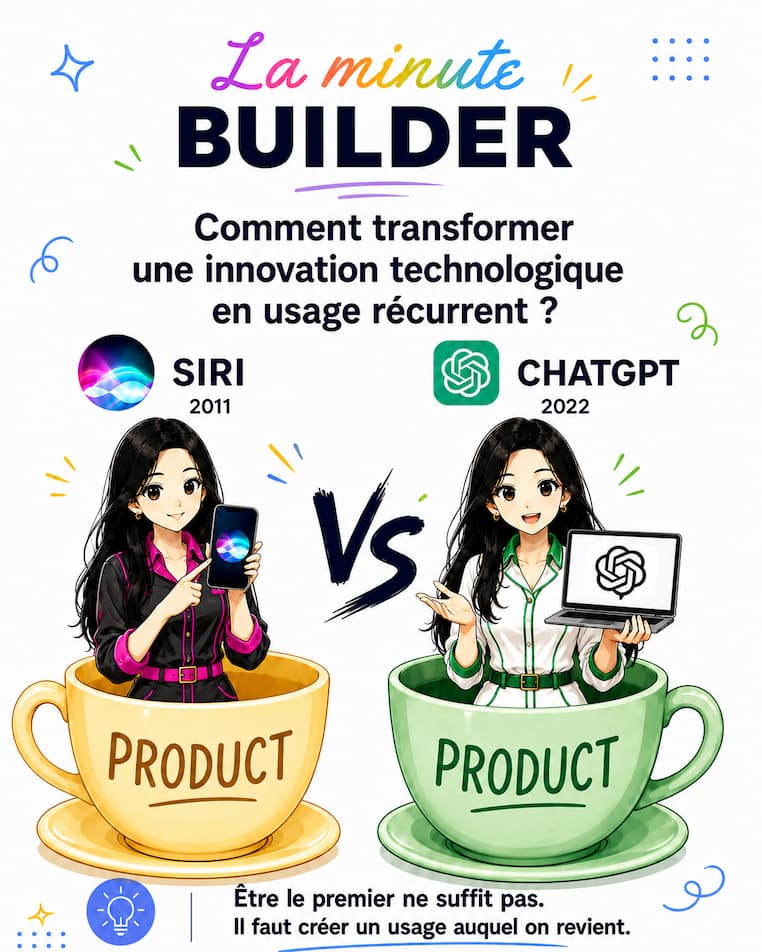
« How do you turn a technology innovation into a recurring habit? »
Launched in 2011, Siri was 11 years ahead of ChatGPT.
Built into the iPhone, available by voice and distributed to millions of users, Apple's assistant had everything it needed to become the reference.
Yet for a long time, Siri stayed focused on precise commands:
- Set an alarm
- Call a contact
- Check the weather
- Create a reminder
Then ChatGPT arrived, in November 2022
No native integration in a smartphone.
No revolutionary voice command.
Only a conversation window.
But one essential difference: the user no longer has to memorize a command. They can express an intent.
Write, learn, code, think, analyze, create…
ChatGPT did not simply improve the virtual assistant. It widened the definition of what an assistant could do.
Within a few months, the product passed 100 million weekly users.
The lesson for Product Builders
- Being first does not guarantee you stay the reference.
- Massive distribution does not automatically create retention.
- Shipping more features is not enough to create usage.
- Users come back when a product answers a recurring intent with immediate value.
- A feature can be overtaken by a product that became a platform.
Today, Apple is in turn turning Siri into a conversational assistant through Apple Intelligence.
Proof that ChatGPT did not only win users: it shifted their expectations.
« An innovation becomes a habit when it no longer asks the user to adapt to the technology, but lets the technology adapt to their intent. »
Sources
Apple — Siri launch in 2011: https://lnkd.in/eMm2etYW
OpenAI — ChatGPT adoption: https://lnkd.in/eMU5ra4x
Apple Intelligence and the evolution of Siri: https://lnkd.in/eu3hnzt4