La Minute Builder #4 — Who are we building this product for?
I’ve seen technically brilliant products fail.
And much simpler products become global successes.
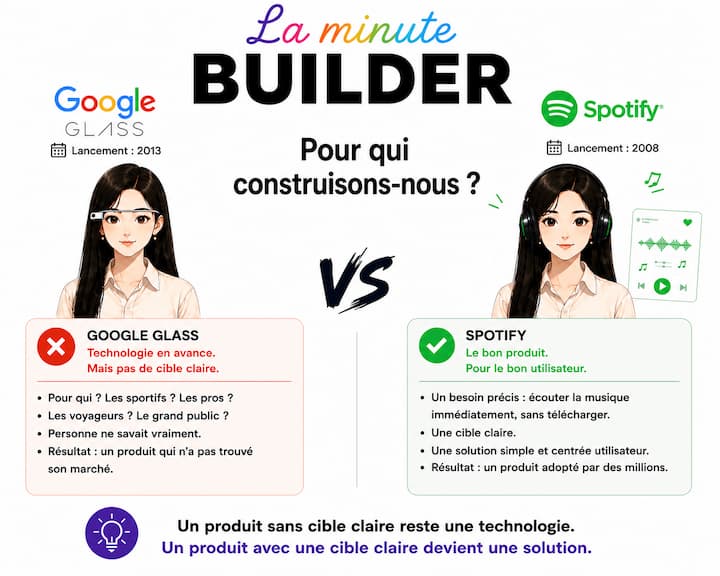
In this edition of La Minute Builder, Google Glass and Spotify illustrate why a clear target matters.
« Who are we really building this product for? »
The same question contributed to Spotify’s success and Google Glass’s failure.
Google Glass (2013)
Technologically, it was impressive.
Connected glasses capable of displaying real-time information, taking photos, filming and responding to voice commands.
The problem?
Google never clearly identified its primary user.
Was it for athletes? Travelers? Professionals? The general public?
Result: technology ahead of its time, but a product that never found its market.
Spotify (2008)
Spotify didn’t try to please everyone.
The product addressed a specific need:
- Listen immediately to the music you want.
- Without downloading.
- Without waiting.
- Without managing a file library.
Spotify didn’t start with technology. Spotify started with a clearly identified user and problem.
In both cases, technical quality wasn’t the decisive factor.
The difference lay elsewhere: target clarity.
Before asking: “What features should we build?”
Let’s ask: “Who are we really building this product for?”
Because a product designed for everyone often ends up convincing no one.